

The widespread adoption of stainless steel cookware is no coincidence. From a materials science perspective, stainless steel stands out among various cookware materials primarily due to its unique corrosion resistance mechanism. Stainless steel resists rust because it contains a high proportion of chromium (typically no less than 11.7%). When chromium reacts with oxygen, it forms an extremely dense chromium oxide film on the metal surface—only a few nanometers thick but highly effective at isolating the metal substrate from corrosive external media.
The current mainstream food-grade stainless steel on the market is 304 stainless steel, containing approximately 18% chromium and 8% nickel. This composition gives 304 stainless steel excellent corrosion resistance and workability, withstanding temperatures up to 800°C—well above the range of everyday cooking (stir-frying and deep-frying typically range from 180°C to 240°C). Compared to materials such as wood, plastic, or ceramic, stainless steel offers a smooth surface that resists bacterial growth, withstands high temperatures without deformation, and maintains toughness against breakage. These properties make it an ideal choice for modern kitchens.
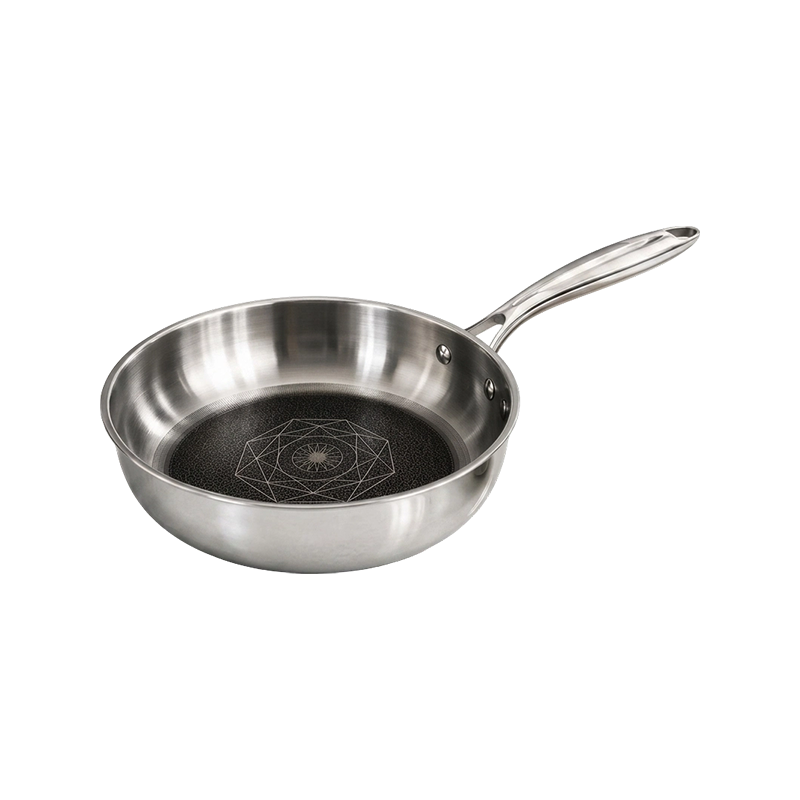
Notably, the stainless steel cookware sector has recently seen significant breakthroughs in Triple-Layer Clad technology. By cladding stainless steel with highly thermally conductive aluminum or aluminum alloys, the triple-layer structure preserves the safety and durability of the stainless steel surface while greatly improving heat distribution uniformity—solving the issues of localized overheating and food sticking that plague traditional single-layer stainless steel pans. This composite structure of "inner stainless steel + middle conductive aluminum + outer stainless steel" is becoming the technical benchmark for high-quality cookware.


Home / News / Industry News / Why Have Stainless Steel Pots Become a Kitchen Mainstay? The Evolution of Cooking Tools from a Materials Science Perspective
Industry News
Why Have Stainless Steel Pots Become a Kitchen Mainstay? The Evolution of Cooking Tools from a Materials Science Perspective
Hot Products
Stay in Touch
Wherever you are, TriCore is ready to serve.
Company Details
24/7 Support Center:
(+86) 13085677677
Email: ideat@tricorecooker.com
Address: Factory Building No. 10, No. 529 Cangling Road, Huzhen Town, Jinyun County, Lishui, Zhejiang, China
Get direction
Copyright © Zhejiang IDEAT Houseware Products Co., Ltd. All rights reserved.
